Patient Data Is the Most Valuable Target in Cybercrime.
Your IT Needs to Be Built Around That Reality.
Why Healthcare Providers Face the Highest IT and Cybersecurity Stakes
Medical practices, clinics, and health systems hold protected health information (PHI) — and attackers know it. Patient records sell for far more on the dark web than financial data. Healthcare organizations also face enormous pressure to restore access quickly after an incident, which is exactly why ransomware operators target them with confidence.
“A HIPAA breach notification isn’t just a regulatory event. It’s a letter to every patient telling them their most sensitive information was compromised.”
Beyond the threat landscape, healthcare providers in the DMV operate under strict federal and state compliance obligations. HIPAA’s Security Rule mandates specific administrative, physical, and technical safeguards for all electronic PHI. The Breach Notification Rule requires covered entities to notify patients, HHS, and in some cases the media within 60 days of a breach. Our cybersecurity services build and document the controls that satisfy both — and keep you audit-ready year-round.
What Managed IT Services for Healthcare Actually Covers
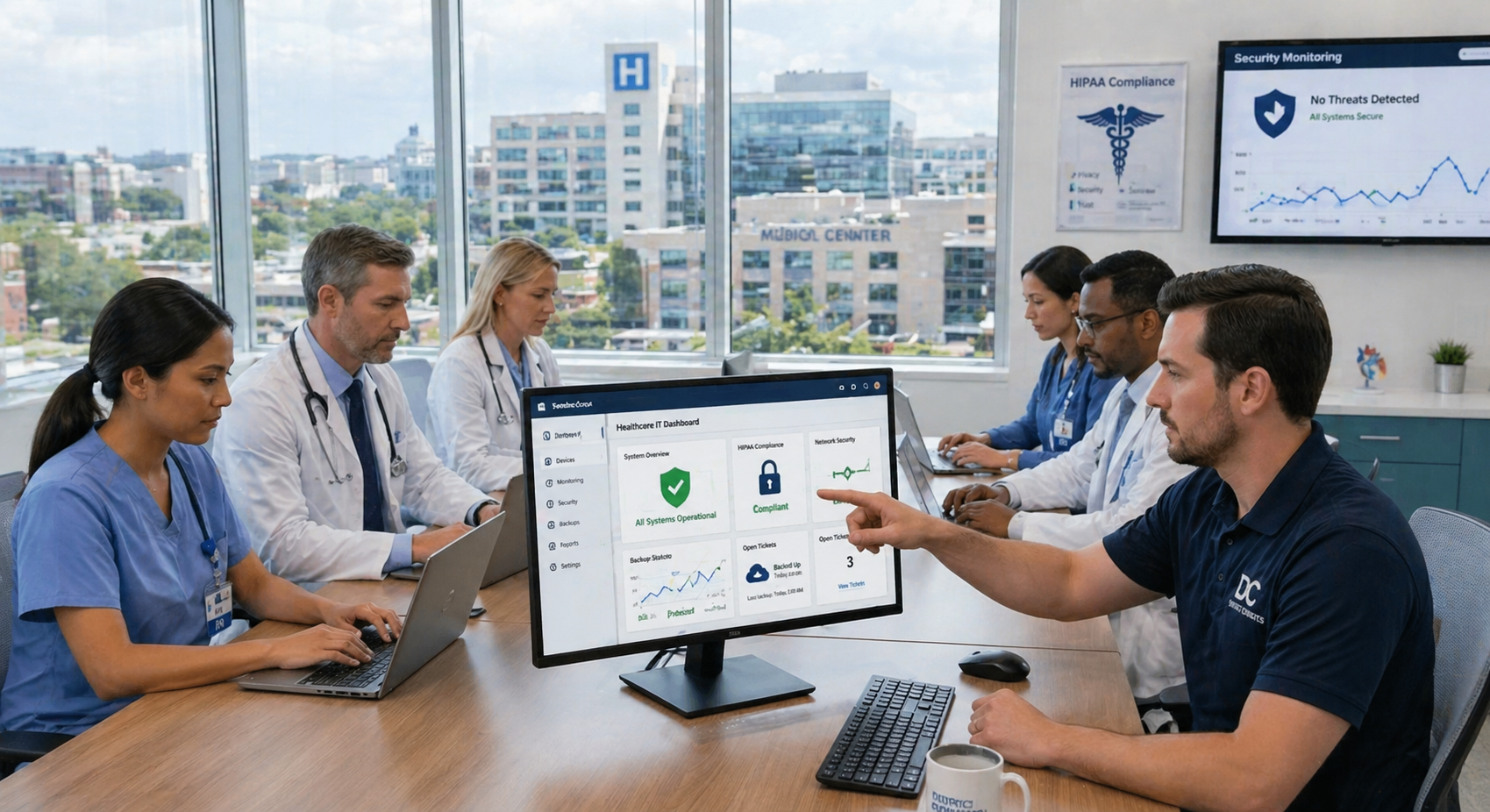
Healthcare IT isn’t general IT with a HIPAA checklist attached. It requires specific controls, EHR platform knowledge, BAA documentation, and an understanding of what PHI protection means operationally. Here’s what our service delivers across four critical areas.
HIPAA Compliance & Documentation
We sign a Business Associate Agreement with your organization before touching any system that handles PHI — making DistrictConnects a documented, accountable partner under HIPAA. We configure your environment to meet the Security Rule’s technical safeguard requirements: access controls, audit logging, automatic logoff, encryption, and integrity controls. We document every control, map it to its HIPAA standard, and maintain the records you need for an OCR audit or security risk assessment. Annual risk assessments, workforce training documentation, and policy templates are included — not optional add-ons. This work connects directly to our Microsoft 365 HIPAA compliance services for DMV healthcare organizations.
EHR Security & Clinical Application Support
Your electronic health record system is the operational core of your practice — and one of the most common entry points for attackers. We support major EHR platforms including Epic, Cerner, Athenahealth, DrChrono, and eClinicalWorks, handling network configuration, secure access controls, backup integration, and end-user support. We isolate EHR systems on segmented network zones so that a compromised workstation can’t reach your patient data directly. We also manage integrations with medical devices, lab systems, and patient portal platforms — keeping the full clinical technology stack secure and operational. Our IT infrastructure management covers the full environment, not just the EHR layer.
Ransomware Defense & Backup Recovery
Healthcare organizations pay ransoms more often than any other sector because the cost of downtime — delayed surgeries, inaccessible records, diverted patients — can exceed the ransom demand within hours. We eliminate that leverage. We deploy endpoint detection and response (EDR) on every device, configure email filtering to block phishing before it reaches clinical staff, store encrypted backups in a separate environment that ransomware can’t reach, and segment your network so an infection on one workstation can’t spread to your EHR server. Our 24/7 monitoring catches threats before encryption starts. And our documented recovery procedures mean your team knows exactly what to do if an incident occurs — not just us. Our cybersecurity risk management service maintains every layer of this defense for DMV healthcare providers.
Secure Remote Access for Clinical Staff
Physicians, nurses, and administrative staff access patient data from clinic workstations, home offices, and mobile devices. Each access point is a potential exposure if remote access isn’t designed properly. We build secure remote access solutions that enforce MFA at every login, tie access to device compliance state, and log all activity for HIPAA audit purposes. Mobile device management policies cover both practice-issued and personal devices used for clinical work. We also implement role-based access controls so that staff members can only reach the data their role requires — a core HIPAA technical safeguard that many practices still handle manually.
How HIPAA Requirements Map to the IT Controls We Implement
HIPAA defines the requirements. Our managed IT service implements and documents the specific controls that satisfy each one — keeping your practice compliant and audit-ready across the DMV.
The section references in the first column (e.g. §164.312) are the specific HIPAA Security Rule citations — the exact standards an OCR auditor checks. Each row shows what that rule requires in plain terms and how we fulfill it.
| HIPAA Requirement | Category | IT Control We Implement |
|---|---|---|
| Access Control (§164.312(a)) | Technical Safeguard | MFA enforcement, role-based access, unique user IDs, auto-logoff |
| Audit Controls (§164.312(b)) | Technical Safeguard | Unified audit logging, log retention, activity monitoring |
| Integrity (§164.312(c)) | Technical Safeguard | Data Loss Prevention, file integrity monitoring, encryption |
| Transmission Security (§164.312(e)) | Technical Safeguard | TLS encryption, encrypted email, VPN for remote access |
| Security Risk Analysis (§164.308(a)(1)) | Administrative Safeguard | Annual risk assessment, documented findings and remediation |
| Workforce Training (§164.308(a)(5)) | Administrative Safeguard | Security awareness training, completion records, policy acknowledgment |
| Device & Media Controls (§164.310(d)) | Physical Safeguard | Endpoint encryption, remote wipe, device inventory management |
Healthcare Organizations We Support Across the DMV
Different practice types carry different IT configurations, EHR environments, and compliance stakes. We design and manage IT for all of them — through our managed IT services across Washington DC, Maryland, and Northern Virginia.
Is Your Practice’s IT Actually HIPAA-Compliant — Or Just HIPAA-Adjacent?
Most aren’t fully compliant. We assess healthcare IT environments across Washington DC, Maryland, and Northern Virginia — identifying gaps against HIPAA’s Security Rule and delivering a documented remediation roadmap.
Serving Washington DC · Bethesda · Rockville · Silver Spring · Arlington · Fairfax · Herndon · Reston · Ashburn · and surrounding DMV communities
Frequently Asked Questions
Is Microsoft 365 HIPAA Compliant for Healthcare Providers?
Microsoft 365 can meet HIPAA requirements, but it doesn’t arrive that way. Microsoft signs a Business Associate Agreement and provides compliant infrastructure — but your organization must configure MFA, audit logging, Data Loss Prevention, encryption, and device compliance controls. Buying Microsoft 365 Business Premium without configuring those controls doesn’t make you compliant. We handle the full configuration and document every control for your compliance records.
What EHR Systems Does DistrictConnects Support?
We support major EHR platforms including Epic, Cerner, Athenahealth, DrChrono, and eClinicalWorks. Our team handles network configuration, secure access controls, backup integration, and end-user support for all major systems used by DMV healthcare practices. We also support practice management software, medical device integrations, and patient portal platforms across the full clinical technology stack.
What Does a Business Associate Agreement Mean for IT Providers?
A BAA is a legally required contract under HIPAA between your practice and any vendor that handles protected health information. As your managed IT provider, DistrictConnects signs a BAA with your organization before we access any system that touches PHI — accepting documented responsibility for safeguarding that data. Many IT providers skip this step. We treat it as the first action of every healthcare engagement, not an afterthought.
How Does Managed IT Help Healthcare Practices Prevent Ransomware?
Healthcare is the most targeted sector for ransomware because practices face intense pressure to restore access fast. Effective protection needs layered controls: endpoint detection and response (EDR) on every device, email filtering to catch phishing before it reaches staff, encrypted backups in a separate environment that ransomware can’t touch, network segmentation to contain any infection, and 24/7 monitoring to detect threats early. We build and actively manage every layer of this defense. Schedule a consultation to assess your current exposure.