
Your Cameras Are Running.
But Is Your System Actually Recording?
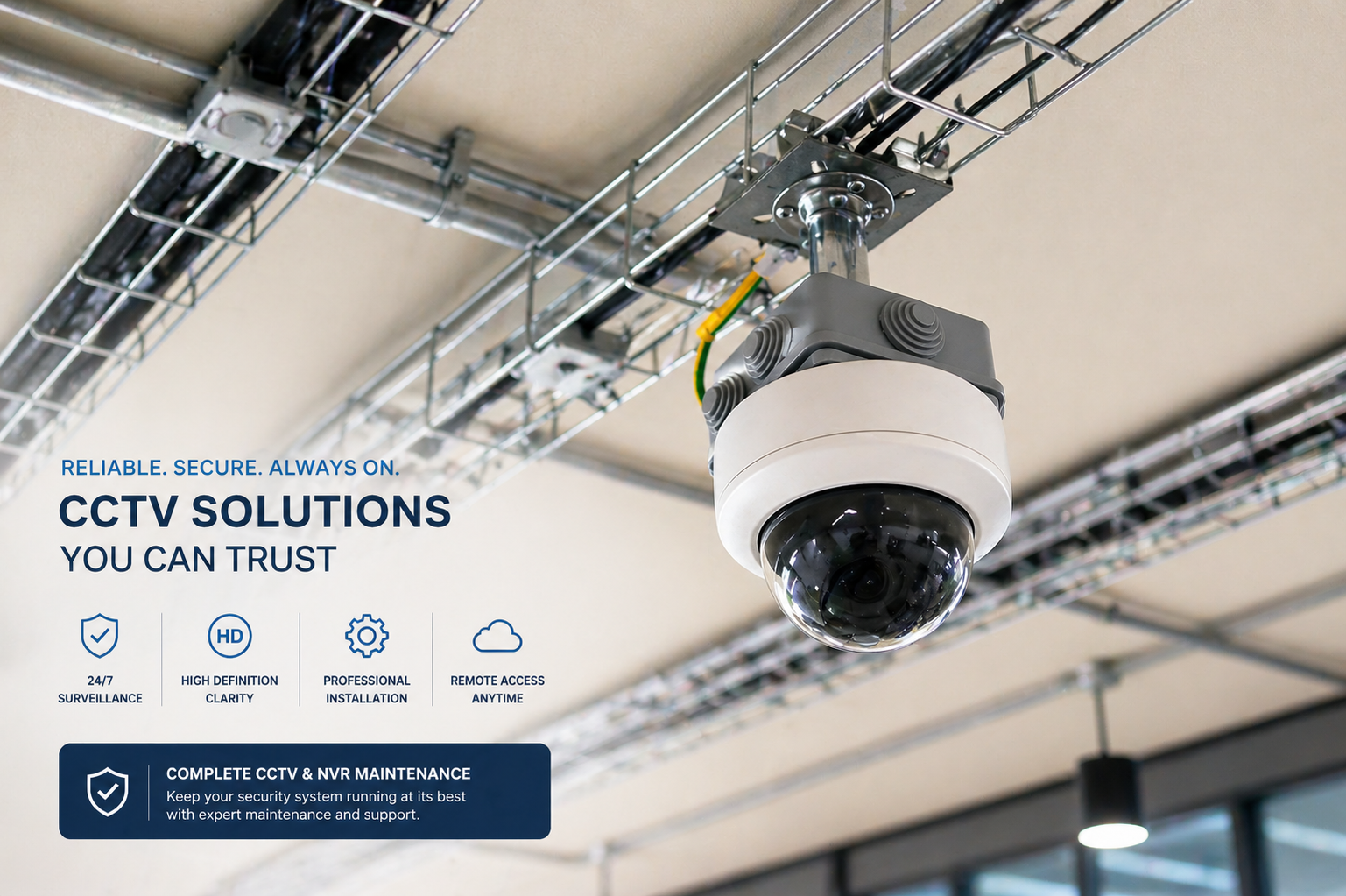
Why CCTV and NVR Maintenance Gets Neglected — And What It Costs
Surveillance systems fail quietly. Unlike a server that crashes visibly or a network that drops connections immediately, a CCTV system can appear fully operational while recording nothing useful. Cameras still show live feeds on monitors. Indicator lights stay green. But the NVR drive is full, a lens is fogged, or a cable has corroded — and the footage you’d need for an insurance claim or incident investigation simply doesn’t exist.
“The worst time to discover your security system wasn’t recording is after an incident. The second worst time is during an insurance claim.”
For DMV businesses — retail locations, office buildings, warehouses, medical facilities, and multi-tenant properties — a maintained surveillance system isn’t just a security measure. It’s a liability management tool. Our managed IT services include surveillance system maintenance as part of a complete business technology strategy.
What a Complete CCTV & NVR Maintenance Service Covers
Effective surveillance maintenance isn’t a single task — it’s a layered set of checks across cameras, cabling, storage, and network connectivity. Here’s what we cover across four critical areas.
Camera Inspection & Lens Cleaning
Outdoor cameras accumulate dust, insects, moisture, and environmental debris that degrade image quality over time. We clean lenses on all camera types — bullet, dome, pan-tilt, infrared, and 360-degree units — and inspect housings for water ingress or physical damage. We verify that each camera’s field of view still covers its intended area, checking for obstructions from landscaping, signage, or structural changes that create new blind spots. Night vision and infrared performance gets tested independently from daytime image quality, since IR emitters degrade separately from the main lens. Positioning adjustments and bracket tightening are included — cameras drift more than most owners realize.
NVR Health & Storage Management
The NVR is the brain of your surveillance system — and the most common point of silent failure. We check hard drive health using diagnostic tools that flag early signs of failure before data loss occurs, verify that recording schedules are active and configured correctly, confirm that motion-triggered recording is functioning as intended, and review storage capacity to ensure the system maintains the retention period your business needs. We update NVR firmware when manufacturer updates are available — unpatched NVR firmware is an increasingly common entry point for network intrusions. Remote viewing access gets tested from outside the local network to confirm it works when you need it most. This connects to our broader IT infrastructure management for DMV businesses.
Cable & Connection Inspection
Cabling is the most overlooked component of surveillance maintenance — and outdoor cable runs degrade faster than most businesses expect. We inspect all CCTV camera cables and connectors for physical wear, UV degradation, water damage, and rodent activity. Junction boxes and conduit entry points get checked for moisture ingress. For PoE (Power over Ethernet) systems, we verify that switches are delivering consistent power to each camera. Loose BNC connectors, corroded terminals, and partial cable breaks cause intermittent recording failures that are notoriously difficult to diagnose without a physical inspection. Wireless systems require a different check — we verify signal strength at each camera location and identify interference sources that reduce reliability.
Blind Spot Audit & Coverage Optimization
Businesses change. Offices get reconfigured. Retail layouts shift. New entrances open. Each change can create coverage gaps that didn’t exist when the system was originally installed. We conduct a full blind spot audit comparing your current camera coverage against your facility’s actual layout and access points. Where gaps exist, we recommend repositioning existing cameras, adding units to uncovered areas, or upgrading to wider-coverage options like pan-tilt or 360-degree cameras where fixed-angle units fall short. The audit output is a documented coverage map — useful for insurance purposes and for demonstrating due diligence in security planning. The Security Industry Association (SIA) recommends regular coverage audits as a baseline practice for any commercial surveillance deployment. Our cybersecurity and physical security services treat surveillance coverage as part of an integrated security posture.
Common CCTV Issues, Root Causes & How We Fix Them
Most surveillance problems have straightforward causes — but finding them requires systematic diagnosis rather than guesswork. Here’s how we approach the issues DMV businesses report most often.
| Issue | Most Common Cause | How We Fix It |
|---|---|---|
| Camera not recording | Full or failed NVR hard drive, incorrect recording schedule | Storage health check, drive replacement, schedule reconfiguration |
| Poor video quality | Dirty lens, degraded cable, incorrect resolution setting | Lens cleaning, cable inspection, NVR resolution and bitrate tuning |
| Camera offline | PoE switch failure, cable break, network configuration issue | PoE power test, cable continuity check, network switch diagnosis |
| No remote viewing access | Router port forwarding change, NVR firmware issue, DDNS failure | Remote access reconfiguration, firmware update, DDNS renewal |
| Night vision not working | IR emitter failure, IR cut filter stuck, lens obstruction | IR emitter test, filter cleaning or replacement, lens inspection |
| Coverage blind spots | Camera drift, facility changes, original placement gaps | Blind spot audit, repositioning, coverage upgrade recommendations |
| Intermittent recording drops | Partial cable break, loose connector, network instability | Cable continuity test, connector re-termination, network path review |
Business Types We Support Across the DMV
Surveillance maintenance needs vary by facility type, camera count, and operational hours. We maintain CCTV and NVR systems for all of them — across Washington DC, Maryland, and Northern Virginia.
When Did You Last Verify Your System Was Actually Recording?
Most businesses can’t answer that question. We inspect CCTV and NVR systems for businesses across Washington DC, Maryland, and Northern Virginia — identifying failures before they cost you footage you can’t recover.
Serving Washington DC · Bethesda · Rockville · Silver Spring · Arlington · Fairfax · Herndon · Reston · Ashburn · and surrounding DMV communities
Frequently Asked Questions
How Often Should CCTV Cameras Be Maintained?
Most commercial CCTV systems need a full inspection every 3 to 6 months. High-traffic environments — retail, warehouses, parking structures — benefit from quarterly visits because lenses accumulate debris faster and cables take more physical stress. At minimum, every 6-month check should cover lens cleaning, cable inspection, NVR storage health, recording schedule verification, and remote access testing. DistrictConnects offers ongoing maintenance plans so nothing slips through the cracks between visits.
What Does an NVR Do in a CCTV System?
An NVR (Network Video Recorder) records, stores, and manages video footage from IP cameras across your network. It controls recording schedules, motion-triggered capture, footage retention periods, and remote viewing access. It’s the core of any modern IP camera system — if the NVR’s hard drive fills up or fails, your cameras keep showing live video while recording nothing. That’s why proactive NVR health monitoring matters more than most businesses realize.
Why Is My CCTV Not Recording?
The most common causes are a full or failing NVR hard drive, an incorrect or disabled recording schedule, a lost network connection between the camera and NVR, or a firmware issue. We diagnose and resolve CCTV recording failures for businesses across the DMV — often remotely the same day for network and configuration issues, with on-site visits for hardware failures. Contact us to diagnose your system.
What Is the Difference Between Wired and Wireless CCTV Maintenance?
Wired systems need regular physical inspection of cables, connectors, and conduit — especially outdoor runs exposed to weather, UV, and temperature cycling. Wireless systems require network signal strength monitoring, interference checks, and firmware updates on the cameras themselves. Both systems need the same NVR maintenance, lens cleaning, coverage audits, and recording verification on the same schedule. Neither is truly “set and forget” — the maintenance tasks just differ by layer.