A Firewall Out of the Box Is Not a Firewall.
A Configured, Monitored, and Maintained Firewall Is.
Why Firewall Implementation Is More Consequential in the DMV
The DMV’s concentration of regulated industries — federal contractors, healthcare providers, legal firms, and financial institutions — means that network security failures carry consequences well beyond operational disruption. A misconfigured firewall in a healthcare practice creates HIPAA exposure. In a government contractor environment, it can trigger federal contract reviews. In a financial services firm, it opens regulatory liability.
“A firewall misconfiguration isn’t a technical inconvenience. In regulated DMV environments, it’s a compliance failure waiting to be discovered.”
According to the NIST Cybersecurity Framework, network perimeter controls — including properly configured firewalls — form a foundational layer of any defensible security posture. Our cybersecurity risk management service builds that foundation correctly from deployment through ongoing management.
The Three Enterprise Firewall Platforms We Deploy
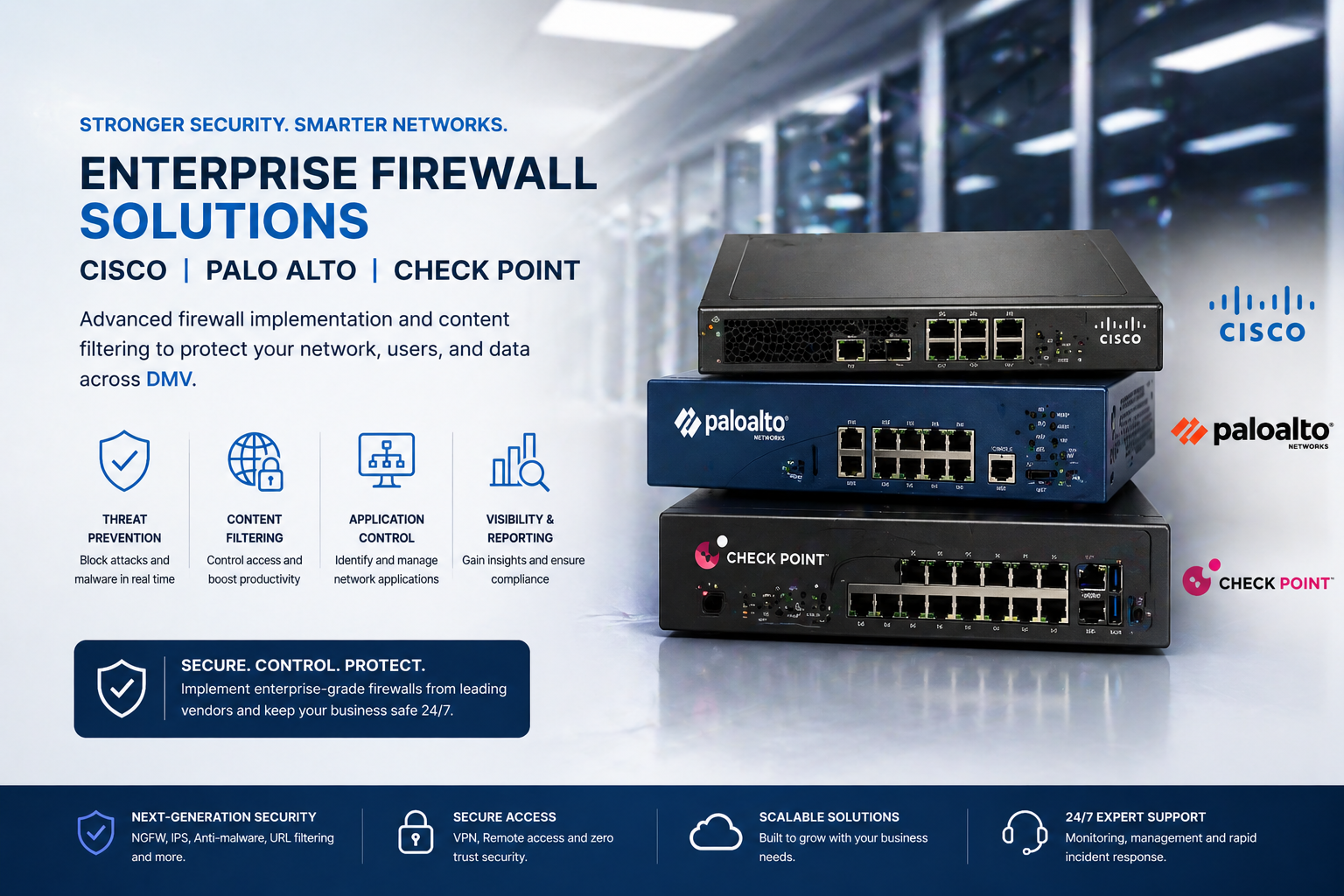
Cisco, Palo Alto, and Check Point each lead the market for different reasons — and the right choice depends on your environment, existing infrastructure, and operational model. Here’s what each platform delivers and where it fits best.
Cisco Firepower & ASA — Deep Infrastructure Integration
Cisco firewalls — including the Firepower NGFW and ASA with Firepower Services — excel in environments already running Cisco networking infrastructure. The integration between Cisco switching, routing, and security components allows for unified policy management and consistent enforcement across the full network stack. Cisco’s threat intelligence platform pulls real-time data from Talos, one of the largest commercial threat intelligence operations in the industry. For DMV businesses with Cisco campus networks, SD-WAN deployments, or Cisco-based data center infrastructure, Cisco Firepower provides deep visibility and tight policy enforcement without introducing management complexity from a separate vendor ecosystem. We handle full deployment, policy buildout, and ongoing management as part of our IT infrastructure management for DMV organizations.
Palo Alto Networks — Application Awareness & Zero Trust
Palo Alto Networks firewalls lead the market in application-layer visibility and zero-trust architecture support. Rather than filtering by port and protocol alone, Palo Alto’s App-ID technology identifies the actual application generating traffic — regardless of what port it uses or whether it’s encrypted. Policy is enforced at that application level. This approach works best for DMV organizations running complex SaaS environments, cloud workloads, and remote workforces where traditional perimeter controls no longer map cleanly to how work actually happens. User-ID ties firewall policy to individual users rather than IP addresses, making access control precise and auditable. WildFire — Palo Alto’s cloud-based threat analysis platform — analyzes unknown files in real time. It distributes new signatures globally within minutes of identifying a threat. For organizations pursuing zero-trust network architecture, Palo Alto is our recommended platform.
Check Point — Centralized Management & Multi-Site Control
Check Point delivers enterprise-grade protection with a centralized management architecture. It’s the strongest choice for multi-site DMV businesses that need unified security policy across multiple locations. The Check Point Security Management Server provides a single pane of glass for policy management, log analysis, and compliance reporting across every gateway in the environment — whether that’s two office locations or twenty. Check Point’s Infinity architecture integrates network, cloud, endpoint, and mobile security under one management platform. This reduces the complexity of running separate tools for each security domain. For DMV organizations with multiple offices across Northern Virginia, Maryland, and DC — or those with federal compliance requirements that demand documented, consistent policy enforcement — Check Point’s centralized model delivers a clear operational advantage.
Cisco vs. Palo Alto vs. Check Point — How to Choose
Each platform excels in different environments. Here’s how they compare across the factors that matter most for DMV businesses — and how our network security assessments determine the right fit for your organization.
| Factor | Cisco Firepower | Palo Alto | Check Point |
|---|---|---|---|
| Best fit environment | Cisco infrastructure, campus networks | Cloud-heavy, SaaS, zero-trust deployments | Multi-site, enterprise, compliance-driven |
| Application visibility | Strong via Firepower | Industry-leading via App-ID | Strong via Application Control blade |
| Threat intelligence | Cisco Talos — one of the largest feeds | WildFire — real-time cloud sandbox | ThreatCloud — 150+ intelligence sources |
| Multi-site management | Good via Cisco Defense Orchestrator | Good via Panorama | Excellent via Security Management Server |
| Zero trust support | Moderate — improving with Cisco ISE | Strongest — built around zero trust | Good via Harmony and Infinity architecture |
| Compliance reporting | Good via Cisco SecureX | Good via Panorama | Excellent — built-in compliance blades |
Content Filtering & Ongoing Firewall Management
Firewall implementation covers the deployment and initial configuration. But a firewall that isn’t actively managed drifts — rules accumulate, exceptions pile up, and the policy that was clean at deployment becomes a tangle of legacy entries that nobody fully understands. Ongoing management is what keeps the protection real.
Content filtering is a core ongoing management task. All three platforms support URL filtering, category-based blocking, and DNS-layer filtering — but these controls require regular tuning as threat categories evolve and business needs change. We manage content filtering policies as part of our ongoing firewall service, updating category assignments, reviewing override logs, and adjusting policy based on actual usage patterns. We also handle firmware updates, security intelligence feed refreshes, rule base audits, and SIEM integration for centralized log analysis.
Industries We Deploy Firewall Solutions For Across the DMV
Different industries carry different firewall requirements — compliance obligations, traffic patterns, and access models all shape the right configuration. We design and deploy for all of them through our managed IT services across Washington DC, Maryland, and Northern Virginia.
Is Your Firewall Configured to Actually Protect Your Network?
Most aren’t — especially if it was deployed by a vendor and never reviewed. We assess your current environment, recommend the right platform, and handle deployment, configuration, and ongoing management across Washington DC, Maryland, and Northern Virginia.
Serving Washington DC · Bethesda · Rockville · Silver Spring · Arlington · Fairfax · Herndon · Reston · Ashburn · and surrounding DMV communities
Frequently Asked Questions
What Is the Difference Between Cisco, Palo Alto, and Check Point Firewalls?
Cisco firewalls integrate deeply with existing Cisco infrastructure and use Talos threat intelligence — the right choice for Cisco-based environments. Palo Alto leads in application-layer visibility and zero-trust architecture, making it ideal for cloud-heavy and SaaS-dependent organizations. Check Point delivers the strongest centralized management for multi-site deployments and compliance-driven environments. The best choice depends on your existing infrastructure, compliance requirements, and how your team operates day-to-day. We conduct a vendor-neutral assessment before recommending any platform.
What Is Content Filtering and Why Does a Business Firewall Need It?
Content filtering lets a firewall inspect and control web traffic by category, reputation, or specific URL — blocking malicious sites, phishing pages, and policy-violating content before it reaches users. In 2026, over 95% of malicious traffic travels over encrypted HTTPS, so effective content filtering requires TLS inspection alongside the filtering rules. Without TLS inspection, content filtering only applies to unencrypted traffic — a shrinking minority of what actually crosses your network. We configure and maintain both capabilities together as part of every firewall deployment.
Is Firewall Implementation a One-Time Project?
No — and treating it that way is one of the most common reasons deployments fail over time. A firewall that’s deployed and never touched drifts out of alignment as your network changes, new applications are added, and the threat landscape evolves. Effective firewall security requires ongoing policy reviews, firmware updates, threat intelligence feed refreshes, log monitoring, and periodic rule audits. We manage all of this as a continuous service through our cybersecurity risk management practice — not a project with an end date.
Can DistrictConnects Deploy a Firewall for a Multi-Site DMV Business?
Yes. We design and deploy firewall solutions for single-site and multi-site businesses across Washington DC, Maryland, and Northern Virginia. For multi-site environments, we implement centralized management platforms — Check Point’s Security Management Server or Palo Alto’s Panorama — that enforce consistent policy across all locations while allowing site-specific configuration where needed. SD-WAN integration, site-to-site VPN, and unified logging across locations are all part of our multi-site architecture. Schedule an assessment to discuss your environment.