
Zero-Click Attacks Explained: How DMV Businesses Can Secure Their Environment
Zero-click attacks require no user interaction to compromise devices. This guide explains the threat and the layered controls businesses in Northern Virginia, Washington DC, and Maryland can deploy to reduce risk.
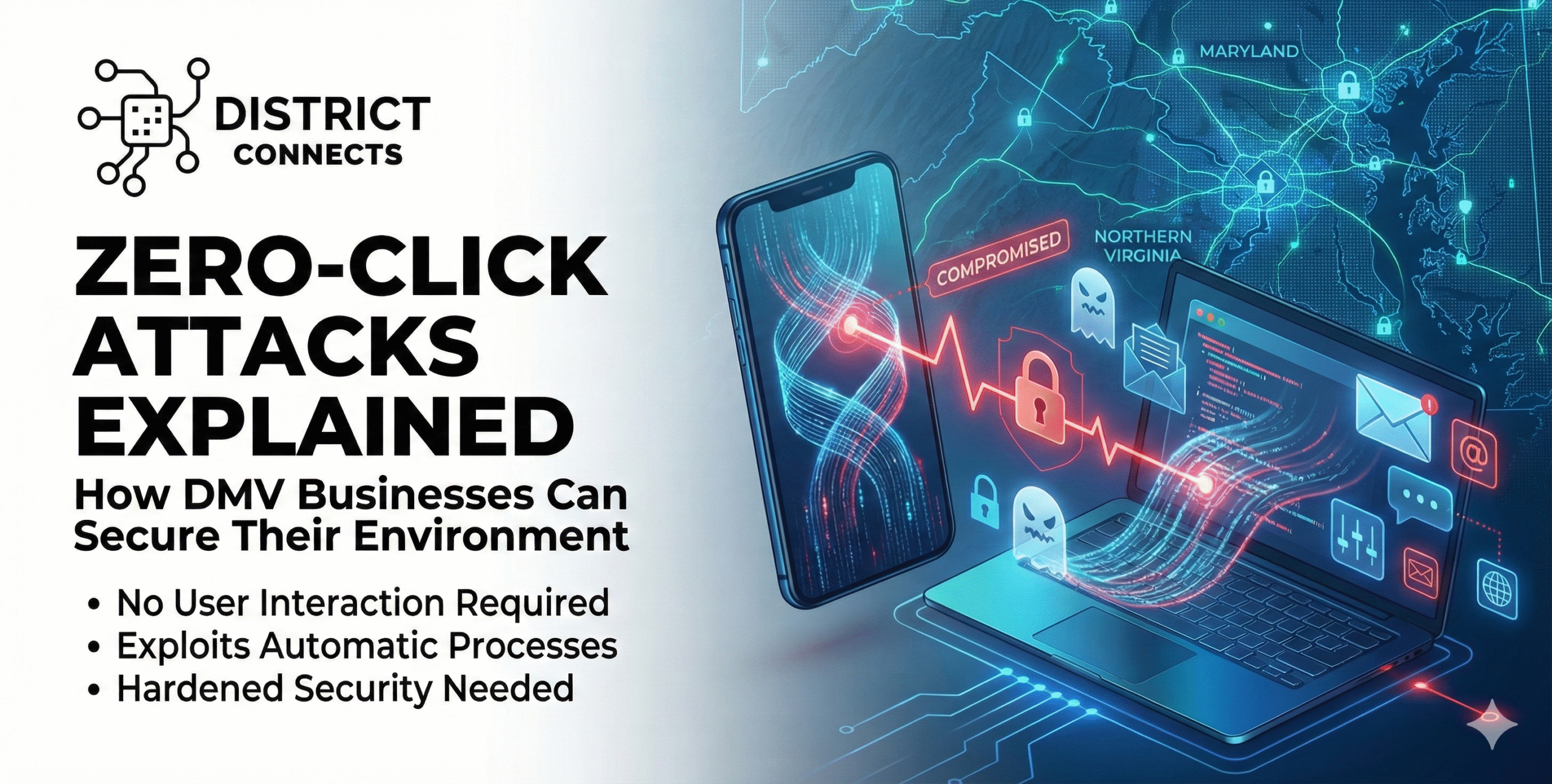
A zero-click attack is an exploit that compromises a device without any clicks—often through software that automatically processes incoming data (email previews, messages, notifications, VoIP calls, or background services).
- Why it matters: Security awareness training alone won’t stop it—there’s nothing for the user to “avoid.”
- How to reduce risk: Patch management, hardened email/collaboration, EDR, firewalls + segmentation, monitoring, and response plans.
- Local impact: DMV businesses with executives, healthcare, finance, and remote users are frequently targeted.
- Action step: Validate your controls with a security assessment and close gaps before an incident.
Table of Contents
What Is a Zero-Click Attack?
A zero-click attack exploits a vulnerability in software that automatically processes content—such as an email preview engine, messaging app, operating system service, or VoIP/collaboration platform. The victim does nothing, yet malicious code can execute silently.
Common zero-click entry points in business environments
- Email preview panes (no attachment opened)
- Messaging apps processing images, messages, or calls
- Mobile OS notification services
- VoIP and collaboration platforms processing background data
Why Are Zero-Click Attacks So Dangerous for DMV Businesses?
Zero-click attacks bypass typical human-error defenses. That makes them especially effective against executives, healthcare providers, finance teams, and regulated industries across Northern Virginia, Washington DC, and Maryland.
- No user behavior to correct — awareness alone won’t stop it
- Often invisible to users and legacy antivirus tools
- Can be used for espionage, credential theft, and ransomware staging
- Downtime, operational disruption, and incident response costs
- Data exposure and reputational damage
- Compliance risk (HIPAA, PCI-DSS, and other security expectations)
Where Do Zero-Click Vulnerabilities Show Up?
Zero-click vulnerabilities have been discovered and patched across major platforms. The key lesson for DMV organizations: no vendor or platform is immune. If your environment uses Microsoft 365, mobile devices, cloud collaboration tools, and modern communications, you should assume these threats exist and design controls accordingly.
Tip: Zero-click risk drops significantly when you combine fast patching, hardening, and modern detection/response tooling.
How to Defend Against Zero-Click Attacks: A Layered Strategy
The most effective approach is defense-in-depth: prevent what you can, detect what you can’t prevent, and contain anything that slips through. DistrictConnects uses layered security for DMV businesses to reduce blast radius and accelerate response.
1) Harden email & collaboration security
- Advanced email security beyond default configurations
- Attachment detonation/sandboxing and exploit inspection
- Controls designed to reduce preview-pane and parsing risks
2) Endpoint protection & behavioral detection (EDR)
- Behavior-based detection for exploit and memory attacks
- Automated isolation of suspicious endpoints
- Device visibility for laptops, desktops, and mobile users
3) Network segmentation & firewall enforcement
- Next-generation firewalls with intrusion prevention (IPS) and application control
- Segmentation to reduce lateral movement and “blast radius”
- Zero-trust access between users, systems, and services
4) Continuous monitoring & incident response
- 24/7 monitoring and alerting
- Anomaly detection aligned to your environment
- Documented incident response playbooks and escalation paths
Helpful internal resources (update links to match your site structure):
• Cybersecurity & Risk Management
• Schedule a Security Assessment
Who Is Most at Risk in the DMV?
Zero-click attacks are often used against high-value accounts and devices. In the DMV, the most commonly targeted environments include:
- Healthcare and medical practices (HIPAA-regulated)
- Law firms and accounting offices
- Executives and leadership teams
- Retail and hospitality environments
- Any DMV business with remote or mobile users
FAQ: Zero-Click Attacks
These are the most common questions business owners and IT managers in Northern Virginia, Washington DC, and Maryland ask about zero-click threats.
What is a zero-click attack?
How do zero-click attacks happen in business environments?
Can a firewall stop zero-click attacks?
Why are zero-click attacks hard to detect?
Which DMV industries are most at risk?
Protect Your Business Before the Silent Attack Happens
DistrictConnects helps businesses across Northern Virginia, Washington DC, and Maryland build secure, resilient environments designed to stop modern threats — including zero-click attacks.
Schedule a Security Assessment
Or call (571) 240-6868