
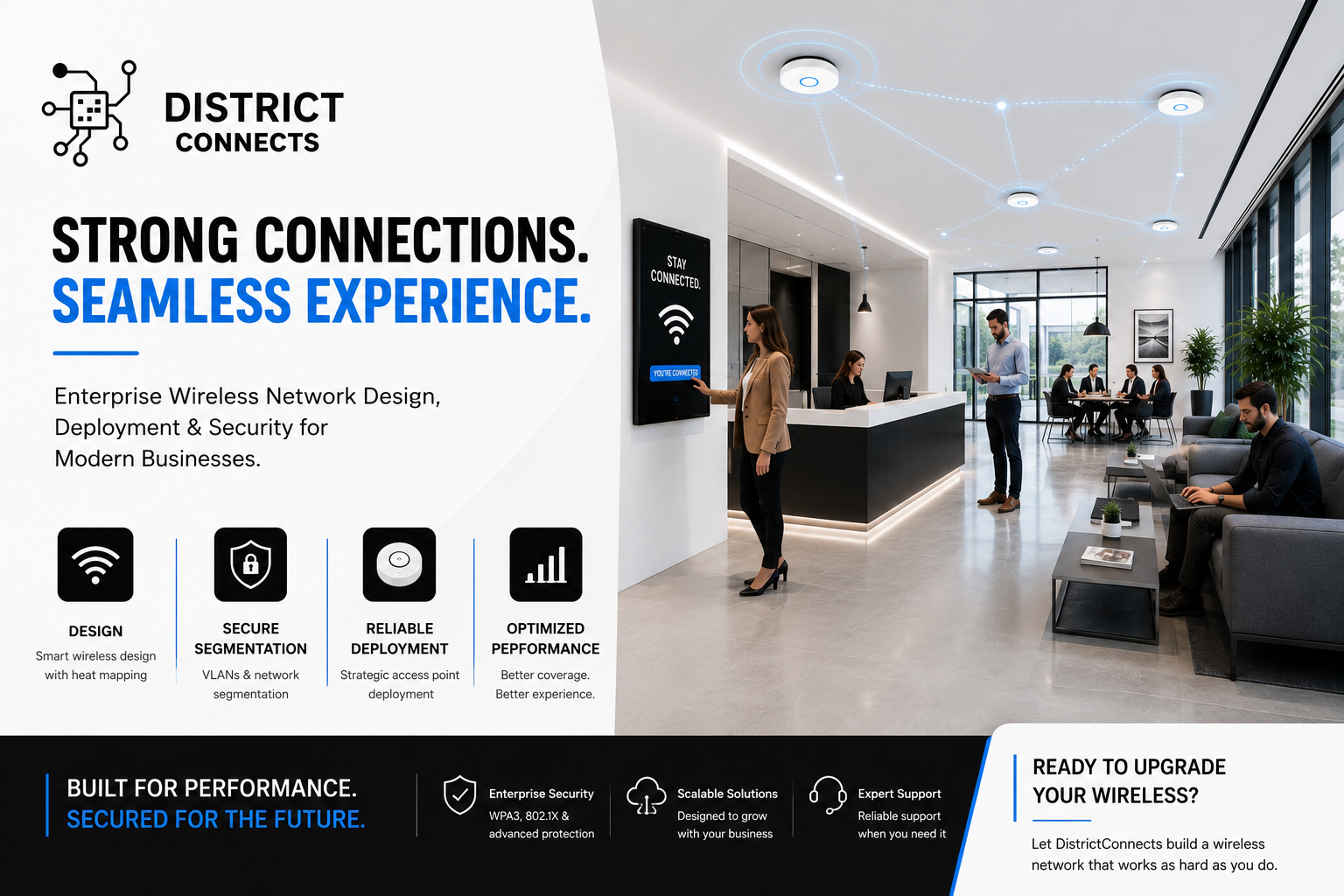
Enterprise WiFi That Works Everywhere.
Designed Before It Is Deployed.
Why Most Business WiFi Fails
These are the problems we’re called in to fix most often, and every one of them is preventable with proper design upfront.
Our Wireless Deployment Process
Every enterprise wireless engagement follows a structured methodology: design first, deploy second, validate third. This is what separates a reliable network from an expensive problem.
Every successful wireless deployment starts with proper site analysis. We use professional enterprise tools to conduct thorough wireless site surveys, identifying coverage requirements, signal strength distribution, RF interference sources, and capacity needs before any equipment is ordered or installed.
- Predictive heat mapping models AP coverage across your floor plan before installation, allowing placement adjustments on paper rather than on the ceiling
- RF interference source identification covering building materials, neighboring networks, and physical obstructions mapped and accounted for
- Capacity planning based on actual device counts and application requirements, not generic estimates
- Channel and frequency planning to minimize co-channel interference across all APs
- Post-deployment validation surveys confirm actual performance matches design targets before handover
We deploy enterprise-grade access points for corporate offices, warehouses, retail environments, medical facilities, and multi-floor commercial buildings, with clean cable management, optimal placement per the survey design, and scalable infrastructure built for growth.
- Enterprise AP installation at survey-specified coordinates with proper mounting and cable management
- SSID design covering naming, authentication, and broadcast configuration aligned to your security requirements
- Band steering to push capable devices to 5GHz and 6GHz bands, reducing congestion on 2.4GHz
- Transmit power and channel optimization tuned for your specific RF environment
- Client load balancing to distribute device counts evenly across adjacent access points
Network segmentation is one of the most important security controls in an enterprise wireless deployment. Without it, a guest device, a compromised IoT camera, or an attacker who has gained WiFi access has a direct path to every device on the network. We design VLAN architectures that isolate each device class and traffic type, limiting lateral movement and reducing the blast radius of any compromise.
- Corporate device VLAN for managed endpoints with full access to internal resources
- Guest WiFi VLAN with internet-only access with captive portal, bandwidth controls, and complete isolation from corporate systems
- IoT device VLAN for cameras, sensors, and smart devices isolated from production systems
- Voice and VoIP VLAN with QoS-prioritized traffic for reliable call quality across the wireless network
- Building automation VLAN covering HVAC, access control, and building management systems on their own segment
- Firewall rules between VLANs enforcing least-privilege inter-segment communication
Enterprise Wireless Security Controls
Wireless security is no longer optional. Every enterprise deployment we deliver includes these security controls as standard.
“Most wireless problems are design problems. Proper site survey, heat mapping, and segmentation before deployment eliminates the issues businesses spend months trying to fix after the fact.”
Cloud-Managed Wireless Platforms We Deploy
We select and deploy the right platform for each environment, based on requirements, budget, and existing infrastructure.
Industries We Support Across the DMV
Every environment has unique wireless requirements covering density, coverage, security, and compliance considerations that differ by industry.
Need Professional Wireless Design and Deployment?
DistrictConnects designs, deploys, and manages enterprise wireless networks across Northern Virginia, DC, and Maryland, with proper heat mapping, segmentation, and security built in from day one.
Serving Fairfax · Arlington · Reston · Tysons · Loudoun County · Washington DC · Maryland
Frequently Asked Questions
Why Is Wireless Heat Mapping Important?
Heat mapping determines optimal access point placement, coverage areas, interference sources, and capacity requirements before deployment. Predictive heat mapping models coverage in advance so AP locations can be adjusted on paper rather than after installation in the ceiling. Post-deployment validation surveys then confirm actual performance matches design targets. Without heat mapping, deployments frequently result in dead zones, overloaded APs, and coverage gaps that are expensive and disruptive to fix after the fact.
What Is VLAN Segmentation in a Wireless Network?
VLAN segmentation separates different device groups and traffic types onto isolated network segments. Corporate devices, guest WiFi, IoT devices, security cameras, VoIP systems, and building automation each operate on their own VLAN with firewall rules controlling what can communicate with what. This improves security by limiting lateral movement if any device is compromised, and improves network performance by reducing broadcast traffic. Without segmentation, a guest device or compromised IoT camera has a direct path to every other device on the network.
Can You Deploy Multi-Floor Wireless Environments?
Yes. DistrictConnects designs and deploys wireless solutions for multi-floor offices, warehouses, large commercial buildings, and multi-tenant properties across Northern Virginia, DC, and Maryland. Multi-floor deployments require careful attention to vertical signal overlap between floors, per-floor channel planning to prevent co-channel interference, and roaming configuration that handles vertical movement between floors as cleanly as horizontal movement across a single floor.
What Enterprise Wireless Platforms Does DistrictConnects Deploy?
We deploy and manage Ubiquiti UniFi, Cisco Meraki, Aruba Networks, and other enterprise cloud-managed wireless platforms. Platform selection is based on your environment, budget, management requirements, and existing infrastructure. We recommend the right platform for each deployment rather than defaulting to a single vendor. See our Ubiquiti UniFi installation page for a detailed breakdown of that platform specifically.
Do You Support Guest WiFi Deployments?
Yes. We deploy isolated guest wireless networks with bandwidth controls, captive portals, usage policies, and full traffic isolation from corporate resources. Guest networks should never have direct access to internal systems. Proper isolation is both a security requirement and a baseline control for cyber insurance coverage. We configure guest networks as part of every enterprise wireless deployment.
Can DistrictConnects Manage Wireless Networks After Deployment?
Yes. As part of our managed IT services in Northern Virginia, DC, and Maryland, we provide ongoing wireless monitoring, performance optimization, firmware management, and troubleshooting. Proactive management ensures wireless performance stays consistent as device counts, usage patterns, and RF environments change over time. Contact us to discuss your wireless project.